
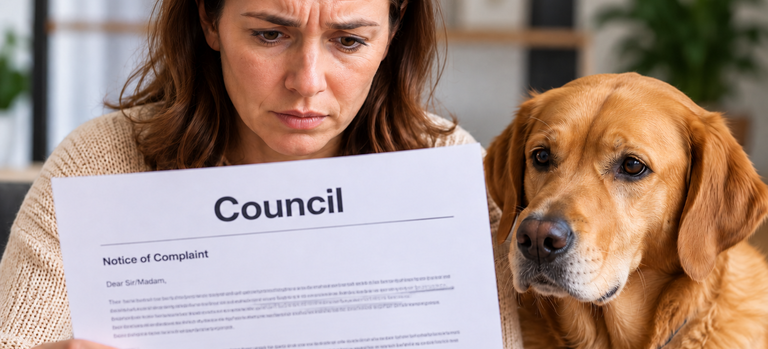
Council has contacted me with a complaint about my dog. What should I do?
It might start with a phone call, an email, a letter, or a dog control officer at your door.
Someone has complained about your dog and Council wants to hear from you.
The complaint might be about barking. Your dog getting out. An allegation that your dog wasn't under control. Or something more serious, such as your dog rushing at, biting or attacking someone.
Whatever the complaint, don't panic — but don't ignore it either.
What you say and do at this stage can affect what happens next.
First, find out what the complaint is actually about.
Before trying to explain or defend what happened, make sure you understand what is being alleged:
-
What does Council say my dog has done?
-
When and where is it alleged to have happened?
-
Who made the complaint?
-
Is Council simply making enquiries, or are they considering formal action?
-
Has Council asked me to provide a statement or attend an interview?
There is a big difference between a neighbour complaining about barking and Council investigating an alleged dog attack.
Understanding where you are in the process helps you decide what to do next.
What can someone complain about?
Council deals with a surprisingly wide range of dog complaints. These can include:
Barking or howling
A neighbour may complain that your dog is creating a nuisance through persistent and loud barking or howling.
The Dog Control Act gives dog control officers and rangers specific powers in relation to barking complaints, including the ability in appropriate circumstances to issue a written notice requiring steps to abate the nuisance. There is also a statutory objection process if such a notice is issued.
Roaming or getting out
The complaint might be that your dog was wandering, escaped from your property, or was somewhere it should not have been.
Dog owners have obligations to keep their dogs under control, and councils can also have local dog control bylaws dealing with where and how dogs may be exercised or controlled.
Rushing or frightening someone
A complaint may be that a dog rushed at or startled a person, another animal or a vehicle. The Dog Control Act contains specific provisions dealing with rushing behaviour.
A bite or attack
At the more serious end, Council may be investigating an allegation that your dog attacked a person or another animal.
That can potentially lead to prosecution and other significant consequences for both you and your dog.
Other dog control issues
Complaints and enforcement can also involve registration, microchipping, failure to comply with restrictions, or the way a dog is being kept or controlled. The exact position can depend on both the Dog Control Act and your local council's dog control policy and bylaws.
Council wants to speak to me. What should I do?
Get in contact with us.
It is natural to want to explain what happened immediately, particularly if you believe the complaint is unfair or only tells one side of the story.
But remember that what you say becomes part of Council's evidence.
Before giving a detailed statement, it can be sensible to understand:
-
What is being alleged?
-
What information does Council already have?
-
What offence or other action is being considered?
-
What evidence might support your account of what happened?
Getting legal advice doesn't mean refusing to cooperate with Council. It means making an informed decision about how best to respond.
What can Council do?
That depends very much on what Council is investigating.
The outcome could be relatively minor. In other cases, Council may have powers to issue notices or infringements, impound a dog, classify a dog as menacing or dangerous, or commence a prosecution. The Dog Control Act provides different powers and procedures for different situations.
The important thing is that a complaint is not the same thing as a proven offence.
And contact from Council does not necessarily mean Council has already decided what happened.
This is why the early stage can be important: there may still be an opportunity to make sure Council receives an accurate and complete picture before decisions are made.
What evidence should I keep?
Evidence can disappear surprisingly quickly.
If there has been an incident involving your dog, preserve the evidence as much as possible.
This can include things such as:
-
Photographs or video of the location, gates, fences, signs and surrounding area.
-
CCTV, doorbell or phone footage before it is automatically overwritten.
-
Witness details, including people who saw what happened immediately before or after the incident.
-
Photographs of injuries, including any injuries to your own dog.
-
Veterinary records if another animal or your dog received treatment.
-
Council correspondence, infringement notices, classification notices and emails.
And write down your own recollection of what happened while events are still fresh.
Get in contact with us to find out more about what you should be keeping.
I've received a formal notice. Are there time limits?
Possibly — and don't assume you have plenty of time.
Different notices under the Dog Control Act have different processes, specific objection or appeal procedures and deadlines.
If you have received a document headed Notice, Classification, Infringement Notice, Summons or anything else requiring you to respond by a particular date, check the deadline and get in touch promptly.
When should I get legal advice?
You won't necessarily need a lawyer every time Council contacts you about your dog.
But get advice early if:
-
you are being asked to give a formal statement or interview
-
Council is alleging a bite, attack or rushing incident
-
your dog has been impounded
-
Council is considering classifying your dog
-
you have received an infringement notice or formal notice
-
prosecution has been mentioned
-
you are worried your dog could be destroyed
-
you believe Council has only heard one side of what happened
-
you simply don't understand what Council is asking you to do.
A short conversation early on can sometimes prevent a much bigger problem later.
Why DogLawyer?
Dog cases aren't just about law.
I’m Dr Ian Robertson, the Principal of Guardianz. I'm often referred to as 'that guy who's a vet and a lawyer'.
I started my career as a clinical veterinarian, later become a lawyer, and worked as a prosecutor for the Ministry of Primary Industries. Today, I leverage this unique blend of expertise as a defence barrister, specialising exclusively in the field of animal law.
Animal law is not just one of the things I do; it’s the entire focus of my work as a lawyer.
Guardianz is the only law firm in New Zealand dedicated to the practice of animal law. We genuinely care about animal law being done well and the outcome you get.

How do you want to look back on things in 12 months?
What's the best that could happen?
What's the worst?
Smart steps taken at the right time are routinely key factors that affect your outcomes in these matters, so your next step is simply to fill in this contact form.
CONTACT US
You can help us to help you by using the 'Message' section in this form to tell us:
-
Where you are in the country
-
Key dates and details about the problem that you're facing; and
-
What you would like to see as the outcome.
"Bottom line," it doesn’t matter where you are in New Zealand; one way or another, we can help you put your best case forward.